
Sunday, April 11, 2010

Friday, February 5, 2010
Black Holes
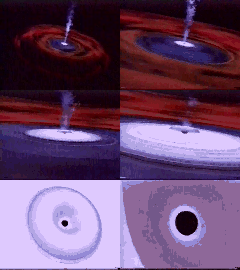 Animation of a Black Hole
 Black Holes
Introduction to Black Holes
Black holes are objects so dense that not even light can escape their gravity, and since nothing can travel faster than light, nothing can escape from inside a black hole. On the other hand, a black hole exerts the same force on something far away from it as any other object of the same mass would. For example, if our Sun was magically crushed until it was about 1 mile in size, it would become a black hole, but the Earth would remain in its same orbit. Even back in Isaac Newton's time, scientists speculated that such objects could exist, even though we now know they are more accurately described using Einstein's General Theory of Relativity. Using this theory, black holes are fascinating objects where space and time become so warped that time practically stops in the vicinity of a black hole.One type of black holes has measured masses ranging from 4 to 15 solar masses, and is believed to be formed during supernova explosions. The after-effects are observed in some X-ray binaries known as black hole candidates.
On the other hand, galaxy-mass black holes are found in Active Galactic Nuclei (AGN). These are thought to have the mass of about 10 billion to 100 billion solar masses. The mass of one of these supermassive black holes has recently been measured using radio astronomy. X-ray observations of iron in the accretion disks may actually be showing the effects of such a massive black hole as well.
Journey into a Black Hole
See an animation of the suspected black hole at the heart of the galaxy M87. AVI format (1.6 Mb)QuickTime format (1.4 Mb)Description
Saturday, January 16, 2010
Solar System

Solar System Montage
Image courtesy NASA
This montage of Voyager spacecraft pictures shows the eight planets, plus four of Jupiter's moons, sprawled against the backdrop of the Rosette Nebula and on the horizon of Earth's moon. In addition to the planets and moons seen in this simulated photo, our solar system contains stars, asteroids and comets, and dwarf planets such as Pluto.

Thursday, January 7, 2010
Talk About A Universe

The universe is the whole cosmic system of matter and energy of which Earth is a part. It is all existing matter and space considered as a whole.
The word comes from the Latin universus, which has historically been used to mean the 'whole world'. Some have argued that the word means "one body of words" and assert that it is a reference to the cosmos as being derived from the Word of God.[1] However, traditional etymology shows the term to be derived from the Latin roots unus "one" and versus meaning "turned". Hence it has come to be used as "turned into one" as in whole or indivisible.[2] Lucretius is said to have first used the contraction in the sense "everything rolled into one".[3]
Contents
[hide]
* 1 Universal Creationism
o 1.1 Origin of the universe
o 1.2 Pre-existing material or spoke into existence
o 1.3 Universe structure
* 2 Age of the Universe
o 2.1 Evolution
o 2.2 Creation
* 3 References
Universal Creationism
Universal creationism is the doctrine or belief that the universe was created by God out of no pre-existent entity. The view is thus philosophically opposed to all forms of evolutionism or pantheism. Universal creationism is a fundamental tenet of the major monotheistic religions.
Origin of the universe
The only cosmogony that mentions the absolute origin of the universe is found in the Bible and writings based on it. All other cosmogonies begin with the space-time-matter universe existing in primeval form, then try to speculate how it "evolved" to its present state. The Bible tells us God created the universe (the heavens and the earth) "in the beginning" (Genesis 1:1 ). It also tells us the pre-existent Jesus Christ, "the image of the invisible God," was the one who created and now sustains everything (Colossians 1:15-17 ).
The first verse of the book of Genesis — "In the beginning God created the heavens and the earth" — is unique in all religion, science, and philosophy. It alone records the special creation of the space–time universe. Space (part of "the heavens"), time ("in the beginning"), and matter ("the earth") make up the space-time-matter continuum that forms the universe. Journalism teachers worldwide have taught this verse to their students as a superb example of a first sentence of a news report. This is because it answers the questions who (God), what (God created), when (in the beginning), and where (heaven and earth) in only 10 words.
Pre-existing material or spoke into existence
The word "created" (Hebrew bara) does not in itself preclude the use of pre-existing material when God created the universe, although this passage does not mention or imply any. Yet Hebrews 11:3 seems to rule out pre-existing material when it says "the worlds were framed by the word of God, so that things which are seen were not made of things which do appear". Scientist and Bible scholar Dr. Henry Morris said this verse makes belief in theistic evolution (the idea that evolution is God’s method of creation) "an oxymoron." Only special creation of the worlds, carried out by God’s "Let it be" command, can account for the things that are seen.
Universe structure
The main items of the universe are galaxies, stars and stellar groupings, and nebulae (clouds of interstellar gas and dust). Smaller inhabitants include the solar system and various assemblages of planets, comets, satellites, asteroids, and meteoroids. The universe also contains gravitational fields and various forms of radiation.

Age of the Universe
Main Article: Cosmic chronology
The Bible explicitly dates the universe as being the same age as the Earth and just over 6000 years old. In fact, according to the Bible, all other celestial bodies are slightly younger than the Earth. At the moment the Earth was created there were no other planets, stars, comets, or other such bodies in the universe. None of these came into existence until the fourth day of the Creation Week (See: Genesis Chapter 1). There is indeed much evidence to support the contention that our solar system, galaxies and even that the entirety of the universe is very young.
In contrast, secular scientists date the universe as being approximately 13.7 billion years using standard cosmologies [4]. The universe is believed to have begun with a cosmic inflation known as the Big Bang, which is then followed by the formation of stars, planets, and galaxies. Based on this chronology the Earth is believed to have formed after our Sun and is dated to be near 4.6 billion years old.
Evolution
Evolutionary ages for the universe have varied wildly over the years. Evolutionist astronomers recently added two billion years to evolution’s speculative age, bumping the age up from 13.7 billion years to 15.8 billion years. [5]
Creation
Despite the small variations among Bible scholars, it is obvious from the account of earth’s history recorded in the Bible that the age of the universe is in the thousands, not billions, of years.
Biblical Implications However, an approximate age for the earth and the universe can be estimated from dates and time-frames within the Bible. The main indicators are these:
1. Genesis 1 gives the time from the universe’s creation to man’s creation.
2. Genesis 5 supplies chronological details from the first man’s creation to the worldwide Flood of Noah’s day.
3. Genesis 11 gives the chronology from the Flood to the time of Abraham.
4. The historical books of the Old Testament supply chronological information from the time of Abraham to the captivity.
5. The chronology of the captivity and restoration can be worked out from some of the prophetic books (principally Isaiah, Jeremiah, and Daniel) and the post-captivity historical books of Ezra and Nehemiah.
6. The intertestament period chronology comes from secular records and the chronology implicit in the "seventy weeks" prophecy of Daniel 9 .
The most famous chronology based on these data is that of Irish Archbishop James Ussher. Ussher calculated the date of creation as 4004 BC, which puts the age of the universe and the earth at slightly more than 6000 years. As noted above, there are problems in arriving at an exact date for the universe’s creation. But Ussher did at least use the biblical data to arrive at his date, and many other calculations come close to his date.
Other Biblical Dates Apart from the Bible, early written records of great civilizations extend back no further than around 3000 BC. Before that there are no written records.
Other dates calculated for the Creation are
* Jewish, 3760 BC
* Lipman, 3916 BC
* Lightfoot, 3960 BC
* Luther, 3961 BC
* Melanchthon 3964 BC
* Kepler, 3993 BC
* Playfair, 4008 BC
* Septuagint, 5270 BC
* Hales, 5402 BC
* Josephus, 5555 BC.
Galaxies

The Andromeda galaxy, also known as Messier 31, is the largest neighboring galaxy to the Milky Way. This photo, a mosaic of ten images captured by the Galaxy Evolution Explorer spacecraft in 2003, shows blue-white regions along the galaxy's arms where new stars are forming and a central orange-white area containing older, cooler stars.
.jpg)
A composite image of the Messier 81 (M81) galaxy shows what astronomers call a "grand design" spiral galaxy, where each of its arms curls all the way down into its center. Located about 12 million light-years away in the Ursa Major constellation, M81 is among the brightest of the galaxies visible by telescope from Earth.
Did the Universe Have a Beginning?
ABSTRACT The big bang theory postulates that the entire universe originated in a cosmic explosion about 15 billion years ago. Such an idea had no serious constituency until Edwin Hubble discovered the redshift of galaxy light in the 1920s, which seemed to imply an expanding universe. However, our ability to test cosmological theories has vastly improved with modern telescopes covering all wavelengths, some of them in orbit. Despite the widespread acceptance of the big bang theory as a working model for interpreting new findings, not a single important prediction of the theory has yet been confirmed, and substantial evidence has accumulated against it. Here, we examine the evidence for the most fundamental postulate of the big bang, the expansion of the universe. We conclude that the evidence does not support the theory; and that it is time to stop patching up the theory to keep it viable, and to consider fundamentally new working models for the origin and nature of the universe in better agreement with the observations.
INTRODUCTION
For most of the existence of our species on this planet, mankind has believed that our home, the Earth, was located at the center of the universe. Copernicus's theory and the Scientific Method finally displaced this strongly held geocentric view with the humbler but more realistic perspective that we are no place special in the universe.
Because this basic perspective change was so difficult to achieve, modern science has since always insisted that any theory seeming to put humans in a special place in the universe was thereby automatically suspect. So when modern cosmologies were first formulated, they were required to obey the "cosmological principle", that the universe should have a uniform matter distribution on the largest scales ("homogeneity"), and look essentially the same for all observers viewing in all directions ("isotropy").
With this background, it therefore came as a surprise in the 1920s when Edwin Hubble found that the light from galaxies appeared redshifted; and that the fainter (and therefore farther away, on average) a galaxy was, the more its light was redshifted. Here was an observable property of the universe that seemed centered on us, and changed uniformly with distance away from us, as if we were at the center of the universe.
The timing of this discovery was critical to further evolution of the theories. At just that time, Einstein's general theory of relativity had received observational support and was gaining in favor with physicists. But there was a serious problem in incorporating general relativity into cosmology. It appeared that gravity made the universe unstable, inducing it to collapse. Wherever galaxies or large assemblies of matter existed, other distant galaxies or assemblies would be attracted toward them; and these mutual attractions would cause all galaxies or large assemblies to be pulled toward one another, since they had insufficient velocity to resist the attraction. Simply put, all sufficiently large structures, including the universe as a whole, must collapse under the weight of mutual gravitation. Yet observations showed this did not happen.
To get around this difficulty, Einstein invented the "cosmological constant" -- a hypothetical repulsive force operating on large scales that prevented the collapse of the universe. This was the unsatisfactory state of affairs when Hubble made his redshift discovery. Physicists of the day immediately knew that, if the redshift of galaxy light was caused by galaxies moving away from us, the implied expansion of the universe would serve to solve the "problem" with the stability of the universe in a far more elegant way.
Friedmann described three possible models in which the universe would appear homogeneous and isotropic, yet be seen as expanding, by all observers in it at the present time:
(1) The open universe, in which the rate of expansion everywhere exceeds the velocity of escape from the rest of the matter in the universe. Such an expansion would continue forever; and space in such a universe can be described as negatively curved.
(2) The closed universe, in which the expansion is eventually halted by gravity and becomes a collapse back to the origin. Such a universe has a finite lifetime unless it bounces and continues expanding and recollapsing forever. Space in this type of universe has positive curvature. As on a sphere, a straight line in any direction eventually returns to its starting point.
(3) The flat universe, in which the expansion is critically balanced at the threshold between open and closed. The expansion goes on forever, asymptotically approaching zero velocity after infinite time has elapsed and the universe has become infinitely large. Space therein has no curvature.
In principle, observations should allow us to determine which type of Friedmann expanding universe we inhabit. We simply measure the cosmic deceleration parameter, q. In a flat universe, the total matter in the universe is just enough to halt the expansion after an infinite time. This corresponds to a cosmic deceleration q0 = 0.5. If the observed value of q0 is larger than 0.5, the universe is closed. If q0 is less than 0.5, the universe is open. If there were no cosmic deceleration, q0 = 0; or if the expansion accelerates due to some hypothetical force of repulsion, q0 < 0. The most widely accepted form of the big bang theory predicts that q0 = 0.5.
Thus, the big bang theory was born from the adoption of Friedmann's premises as the explanation for Einstein's quandary about the collapse of galaxies and Hubble's redshift data. However, in their eagerness to solve these dilemmas, astronomers and physicists were induced to accept a new, if less distressing, way of accepting that the observer was special. It is true that the Earth would occupy no special place in a Friedmann-type universe, and everything would look basically the same in all directions as seen by anyone anywhere. However, everything in the universe would always be at a special time, a finite number of years from the beginning or end of the universe, and evolving accordingly. The universe looked rather different at any two widely spaced moments of time. The Friedmann models still obeyed the original cosmological principle; but they violated the new "perfect" cosmological principle, in which the universe should look essentially the same to any observer at any time as well.
This development was ironic, because one of the accomplishments of the theory of relativity was to show the large extent to which space and time were similar and interchangeable. That symmetry had to be abandoned by the big bang when the perfect cosmological principle was abandoned. As we will discuss, this pragmatic decision to once again allow the observer to be special (observing at a special time) was probably a wrong turn for science.
Something has gone wrong in the field of astronomy. Many widely held beliefs fly in the face of observational evidence. Theories go through such contortions to resolve inconsistencies that the ideas can no longer be explained in simple language. Alternative ideas are often rejected out of hand simply because they challenge the status quo. The result... many of today's theories are unnecessarily complex
Meta Research is dedicated to bringing some common sense back to this field. Here we challenge ideas that have consistently failed to make successful predictions, examine new paradigms, and advocate the ideas found to be most worthy of further consideration and testing.
Intuitively, most of us understand that an idea's popularity is no more an appropriate measure of its validity today than it has been at any other time in history. Yet those who question any widely accepted theories are labeled ignorant, and if they persist are branded cranks, charlatans, or worse. Meta Research does not claim to have all the answers. But here at least it is safe to ask the rude questions... and to make a case for alternative hypotheses.
INTRODUCTION
For most of the existence of our species on this planet, mankind has believed that our home, the Earth, was located at the center of the universe. Copernicus's theory and the Scientific Method finally displaced this strongly held geocentric view with the humbler but more realistic perspective that we are no place special in the universe.
Because this basic perspective change was so difficult to achieve, modern science has since always insisted that any theory seeming to put humans in a special place in the universe was thereby automatically suspect. So when modern cosmologies were first formulated, they were required to obey the "cosmological principle", that the universe should have a uniform matter distribution on the largest scales ("homogeneity"), and look essentially the same for all observers viewing in all directions ("isotropy").
With this background, it therefore came as a surprise in the 1920s when Edwin Hubble found that the light from galaxies appeared redshifted; and that the fainter (and therefore farther away, on average) a galaxy was, the more its light was redshifted. Here was an observable property of the universe that seemed centered on us, and changed uniformly with distance away from us, as if we were at the center of the universe.
The timing of this discovery was critical to further evolution of the theories. At just that time, Einstein's general theory of relativity had received observational support and was gaining in favor with physicists. But there was a serious problem in incorporating general relativity into cosmology. It appeared that gravity made the universe unstable, inducing it to collapse. Wherever galaxies or large assemblies of matter existed, other distant galaxies or assemblies would be attracted toward them; and these mutual attractions would cause all galaxies or large assemblies to be pulled toward one another, since they had insufficient velocity to resist the attraction. Simply put, all sufficiently large structures, including the universe as a whole, must collapse under the weight of mutual gravitation. Yet observations showed this did not happen.
To get around this difficulty, Einstein invented the "cosmological constant" -- a hypothetical repulsive force operating on large scales that prevented the collapse of the universe. This was the unsatisfactory state of affairs when Hubble made his redshift discovery. Physicists of the day immediately knew that, if the redshift of galaxy light was caused by galaxies moving away from us, the implied expansion of the universe would serve to solve the "problem" with the stability of the universe in a far more elegant way.
Friedmann described three possible models in which the universe would appear homogeneous and isotropic, yet be seen as expanding, by all observers in it at the present time:
(1) The open universe, in which the rate of expansion everywhere exceeds the velocity of escape from the rest of the matter in the universe. Such an expansion would continue forever; and space in such a universe can be described as negatively curved.
(2) The closed universe, in which the expansion is eventually halted by gravity and becomes a collapse back to the origin. Such a universe has a finite lifetime unless it bounces and continues expanding and recollapsing forever. Space in this type of universe has positive curvature. As on a sphere, a straight line in any direction eventually returns to its starting point.
(3) The flat universe, in which the expansion is critically balanced at the threshold between open and closed. The expansion goes on forever, asymptotically approaching zero velocity after infinite time has elapsed and the universe has become infinitely large. Space therein has no curvature.
In principle, observations should allow us to determine which type of Friedmann expanding universe we inhabit. We simply measure the cosmic deceleration parameter, q. In a flat universe, the total matter in the universe is just enough to halt the expansion after an infinite time. This corresponds to a cosmic deceleration q0 = 0.5. If the observed value of q0 is larger than 0.5, the universe is closed. If q0 is less than 0.5, the universe is open. If there were no cosmic deceleration, q0 = 0; or if the expansion accelerates due to some hypothetical force of repulsion, q0 < 0. The most widely accepted form of the big bang theory predicts that q0 = 0.5.
Thus, the big bang theory was born from the adoption of Friedmann's premises as the explanation for Einstein's quandary about the collapse of galaxies and Hubble's redshift data. However, in their eagerness to solve these dilemmas, astronomers and physicists were induced to accept a new, if less distressing, way of accepting that the observer was special. It is true that the Earth would occupy no special place in a Friedmann-type universe, and everything would look basically the same in all directions as seen by anyone anywhere. However, everything in the universe would always be at a special time, a finite number of years from the beginning or end of the universe, and evolving accordingly. The universe looked rather different at any two widely spaced moments of time. The Friedmann models still obeyed the original cosmological principle; but they violated the new "perfect" cosmological principle, in which the universe should look essentially the same to any observer at any time as well.
This development was ironic, because one of the accomplishments of the theory of relativity was to show the large extent to which space and time were similar and interchangeable. That symmetry had to be abandoned by the big bang when the perfect cosmological principle was abandoned. As we will discuss, this pragmatic decision to once again allow the observer to be special (observing at a special time) was probably a wrong turn for science.
Something has gone wrong in the field of astronomy. Many widely held beliefs fly in the face of observational evidence. Theories go through such contortions to resolve inconsistencies that the ideas can no longer be explained in simple language. Alternative ideas are often rejected out of hand simply because they challenge the status quo. The result... many of today's theories are unnecessarily complex
Meta Research is dedicated to bringing some common sense back to this field. Here we challenge ideas that have consistently failed to make successful predictions, examine new paradigms, and advocate the ideas found to be most worthy of further consideration and testing.
Intuitively, most of us understand that an idea's popularity is no more an appropriate measure of its validity today than it has been at any other time in history. Yet those who question any widely accepted theories are labeled ignorant, and if they persist are branded cranks, charlatans, or worse. Meta Research does not claim to have all the answers. But here at least it is safe to ask the rude questions... and to make a case for alternative hypotheses.
Subscribe to:
Comments (Atom)
